Beyond the Hype: 5 Counter-Intuitive Truths Shaping HR in 2026
Discover 5 counter-intuitive truths shaping HR by 2026, including the rise of blended workforces and AI fluency, to enhance your team's strategic capabilities.
The "No One Knows" Paradox: When the Experts Are Guessing, Where Do We Go? A few weeks ago, a senior leader at a 20,000-employee multinational shared a revealing story. She was in a high-stakes meeting with IT, Legal, and HR to map out the future of human-robot collaboration. As they debated survival skills, a jarring realization hit her: no one in that room actually knew what they were talking about.
If you feel the crushing weight of this uncertainty, take comfort: acknowledging that "no one knows" is not a failure—it is the first step toward genuine leadership. To move beyond the headlines and the hype, we must understand the fundamental shifts occurring right now. Here are the 5 counter-intuitive truths that will define the HR profession by 2026.
1. The End of "Human-Only" Management
We have been conditioned to view management as a "soft" skill—a uniquely human endeavor built on coaching and empathy. The counter-intuitive truth? We are witnessing the last generation of managers who will look after exclusively human teams.
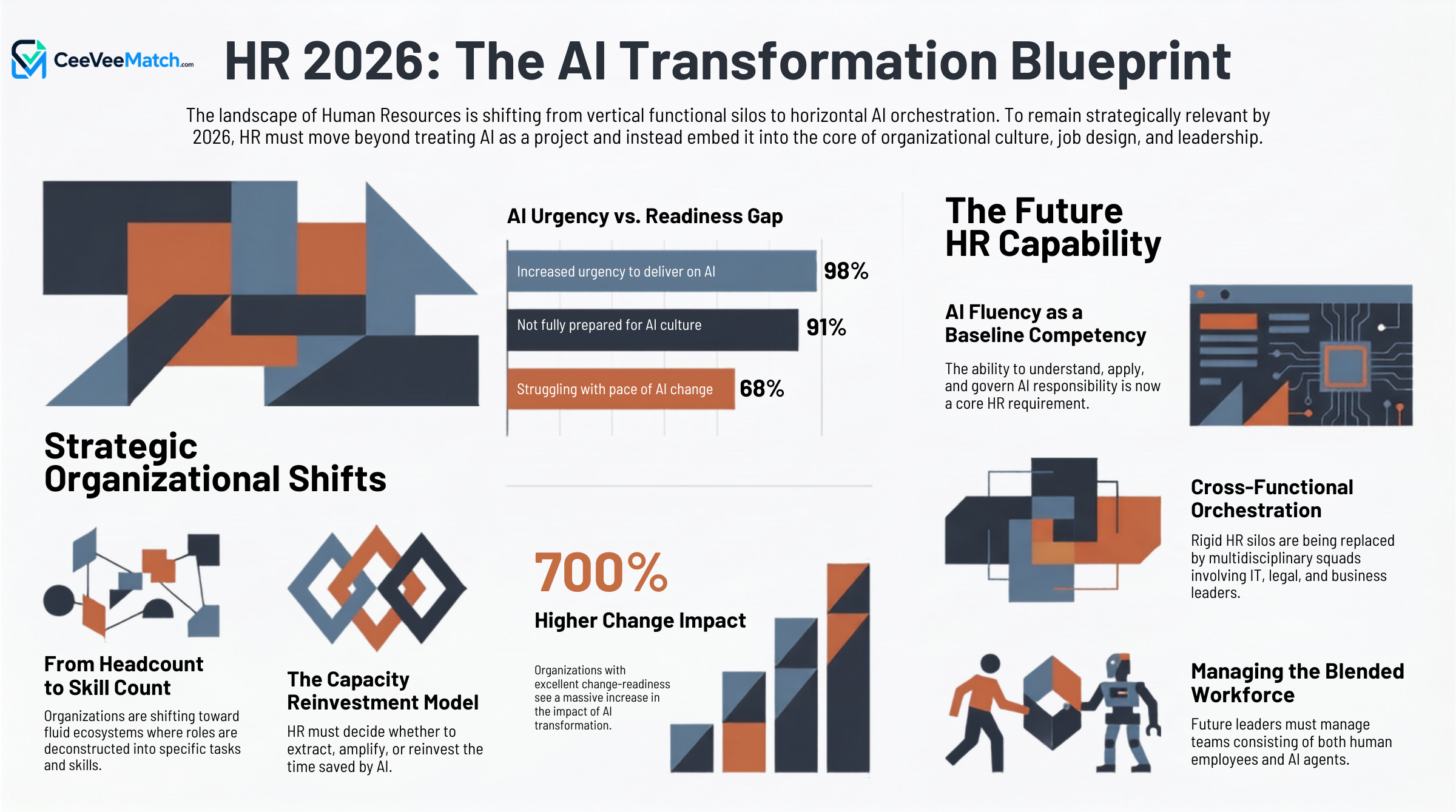
By 2026, the "blended workforce" will be the standard. As AI and humanoid robotics become dramatically cheaper and highly proficient, the new leadership competency is no longer just managing people; it is managing AI agents as "colleagues." "AI is not about technology; it’s about culture. It’s about what type of organization you want to become."
2. The Choice Between "AI Regret" and Capacity Reinvestment
In the rush to automate, organizations risk falling into the trap of "AI Regret"—replacing people with silicon only to lose the invisible cultural glue and human nuance that spreadsheets cannot capture. To avoid this, HR must help leaders navigate AI capacity gains through three lenses: • Capacity Extraction: The "downsizing" route—doing the same work with fewer people. • Capacity Amplification: Producing more volume with the same number of people. • Capacity Reinvestment: The ultimate long-term strategy. This means shifting human talent away from administrative drudgery toward high-value, strategic work. Reinvestment is a commitment to a culture where people are valued for their uniquely human contributions, not their ability to act like machines.
3. The Great Flattening: Deconstructing the "Job"
For decades, the "Job" has been our primary metric. But in 2026, we are moving from "Headcount" to "Skill Count." We are deconstructing traditional roles into their smallest components: tasks and skills.
As AI handles basic data processing and administrative queries, the need for middle management evaporates, driving The Great Flattening of organizational hierarchies. The goal is to let both humans and silicon play to their strengths: AI provides the massive calculation capability, while humans deliver the empathy, context, and judgment.
4. Horizontal Squads vs. "Snake Oil" Vendors
HR is drowning in "AI Snake Oil"—vendors slapping AI labels on basic dashboards. To see through the hype, remember one technical truth: AI does not work vertically; it works horizontally.
If your Recruiting data is siloed away from your Onboarding data, your AI will fail. To survive, HR must dismantle traditional silos and build "Horizontal Squads"—cross-functional teams mixing HR, IT, and business leaders to ensure data flows seamlessly across the entire employee lifecycle.
5. Defining the "D-Shaped" HR Professional
The era of the "T-shaped" professional is evolving. In 2026, we need the "D-Shaped" HR professional:
• The Stem: Your specific role expertise and organizational context.
• The Curve: A new baseline of AI Fluency.
AI Fluency is not about learning to code. It is the ability to Understand, Apply, and Govern AI responsibly. Being self-taught is great, but true fluency means knowing how to spot algorithmic bias, prompt for optimal outcomes, and govern the ethical risks of automation.
Conclusion: HR as the Orchestrator The transition from HR as a support function to a "co-leader of organizational transformation" is the defining shift of our era. We are no longer merely managing resources; we are the orchestrators of a radically new workforce.
Try CeeVeeMatch
Screen 100 CVs in under 5 minutes.
Drop in a JD, drop in your inbox, get a defensible shortlist with reasoning. Free trial — no card surprise.