The Power of Mathematical Programming in Rubric-Based Resume Matching
Transform your hiring process with Mathematical Programming for rubric-based resume matching, enabling objective evaluations and faster, bias-free candidate selection.
The Power of Mathematical Programming in Rubric-Based Resume Matching
In the world of automated candidate evaluation, extracting data from a resume is only half the battle. The real magic happens when we decide what to do with that data. This is where Mathematical Programming steps in, transforming a simple scoring rubric into a powerful optimization engine.
While the "Rubric" provides the criteria, "Mathematical Programming" is the mathematical brain that calculates the absolute best fit.
What is Mathematical Programming?
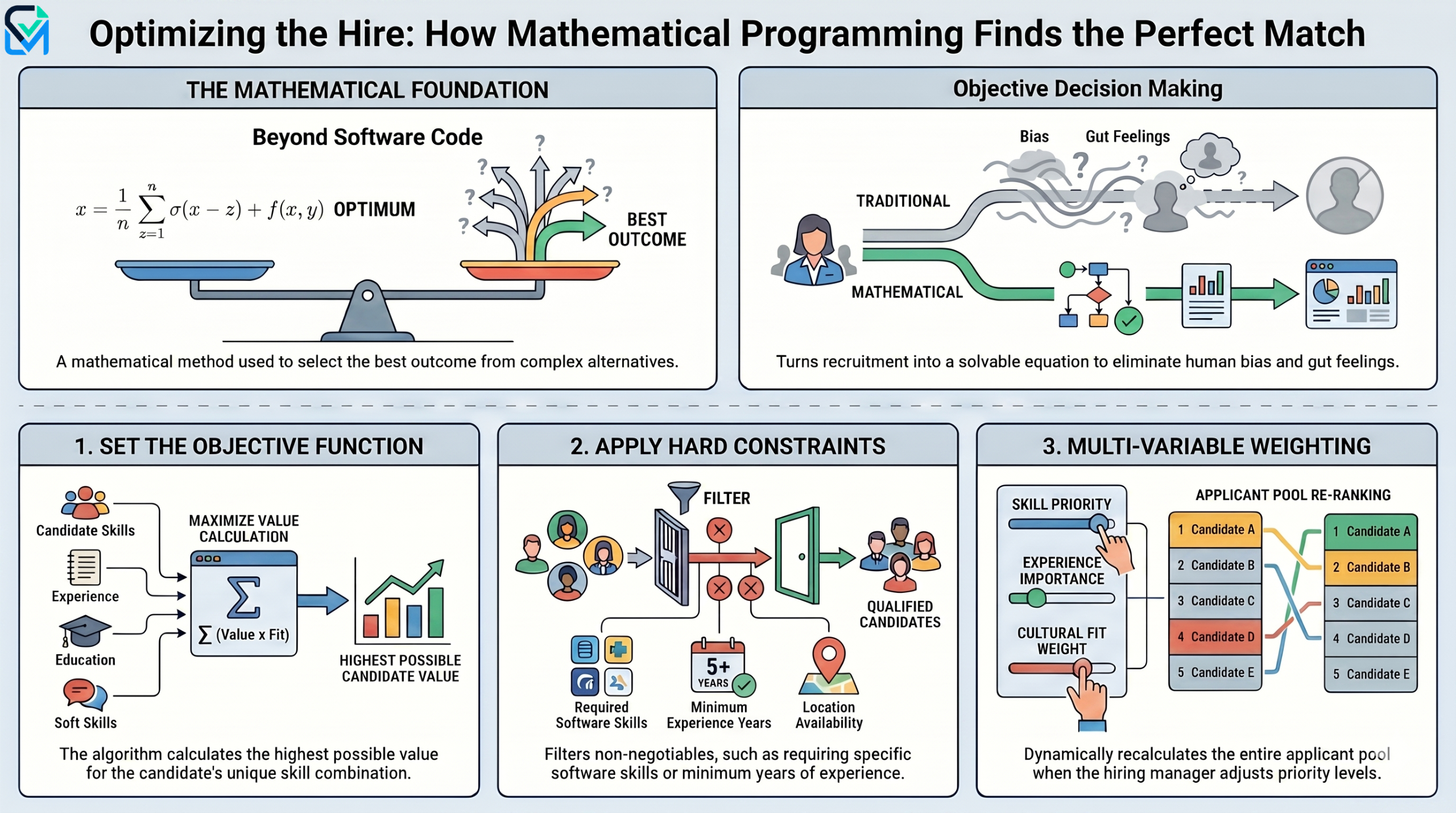
In computer science and operations research, Mathematical Programming (or Optimization) is not about writing software code. It is a mathematical method used to select the best possible outcome from a complex set of alternatives, subject to specific constraints.
When applied to HR and candidate screening, Mathematical Programming turns recruitment into an objective, solvable equation.
How the Optimization Engine Works
Instead of simply adding up points, Mathematical Programming evaluates candidates through three core mathematical components:
1. The Objective Function (Maximizing the Fit)
The algorithm's primary goal is defined by an objective function: to maximize the overall "Fit Score" of a candidate against the Job Description. It looks at the entirety of a candidate's profile and calculates how their unique combination of skills yields the highest possible value for the role.
2. Handling Constraints (The Non-Negotiables)
Real-world hiring has strict boundaries. Mathematical Programming handles these through Constraints. For example, a role might mathematically require:
- Experience Constraint: Must be ≥ 5 years.
- Skill Constraint: Must possess 'Python' capability. If a candidate violates a hard constraint, the mathematical model instantly adjusts their viability, regardless of how high they score in other areas like education or soft skills.
3. Multi-Variable Weighting
The system handles dozens of variables simultaneously. It applies dynamic, mathematical weights to different rubric dimensions. If the hiring manager emphasizes technical skills over education, the algorithm recalculates the entire applicant pool instantly, solving the equation to present a newly optimized ranking.
The Outcome: Objective and Explainable Hiring
By driving the evaluation process with Mathematical Programming, HR teams eliminate human bias and "gut feelings." Every ranking is the result of a rigorous, explainable mathematical equation.
This advanced optimization architecture is the core engine behind CeeVeeMatch.com. By combining structured rubrics with Mathematical Programming, we empower HR professionals to find the mathematically perfect hire faster and more accurately than ever before.
Try CeeVeeMatch
Screen 100 CVs in under 5 minutes.
Drop in a JD, drop in your inbox, get a defensible shortlist with reasoning. Free trial — no card surprise.